“Here’s the data. Good luck with it.”
Most people who work with data have received it this way. A file, an export, a link to a table. Sometimes a short email. Rarely more. And then the real work begins. What does this column mean? Why are some values empty? Is this the same “customer” as in our own system? Are we even allowed to use it for this? Nobody planned it this way. Nobody is being careless. It is simply how data has always moved between teams and organisations: the data goes, and the knowledge about it stays behind.
Think about what that means. The team behind the source system understands the data, because it works with it every day. The receiver has to reconstruct that understanding from column names, samples and conversations. Then the next receiver, in another department, a year from now, perhaps after the original team has moved on, does it all again. We keep paying to recover knowledge that already existed where the data began.
For a long time, that was annoying but manageable.
Picture how it used to go. A department needed figures for the monthly management report. Someone requested an export, an analyst spent a few days making sense of it, and a handful of people looked at the result before it reached a meeting. The data came from a few systems everyone knew, and you always knew who to call: the colleague who built the report, the application manager who knew why a field was misused, the analyst who warned you over coffee not to trust the figures from before the system change. The context of the data lived in people’s heads, and it travelled with them. If a number looked odd, someone noticed, because a person stood between the data and every decision. Mistakes happened, but they were small, slow and usually caught.
Now picture today. The same organisation pulls data from dozens of sources, inside and outside its own walls. It flows into platforms continuously, is combined automatically, and feeds dashboards, algorithms and AI agents that act on it within seconds. Nobody looks at every result anymore; there is simply too much. The person who used to stand between the data and the decision has quietly disappeared from the chain.
The way we hand over data has not changed. What happens to it afterwards has changed completely. A guess that once cost an analyst an afternoon can now flow, unchecked, into thousands of decisions.
And think of how many places that happens. The data warehouse and BI team draw on many source systems at once: CRM, ERP, finance, HR and dozens more. Each of them has to be understood, and the work multiplies with every source added. The same goes for the analysts, the data scientists, the AI project, the partner who receives an export, the team preparing the next migration. Each of them sits down with the same data and reverse-engineers it from scratch: how is it structured, what do the values mean, which rules apply? Each of them spends weeks on it, at real cost in time and money.
And each of them fills the gaps with assumptions. What does an empty field mean? Is this value an error or an exception? How good does the data need to be, and is it good enough? Every team answers those questions differently, without knowing the others did the same work.
The result: the same source, understood five different ways, by five teams that are each not quite sure they got it right. That is how two reports built on the same data end up telling different stories, and why nobody can say with confidence which one is correct.
That is also why “good luck with it” is no longer just annoying. It has become a dead end. Every new source adds another round of guessing, every new receiver repeats it, and every AI agent acts on the result before anyone has looked.
- You cannot hire your way out of it. There will never be enough people to reverse-engineer data at the speed it now arrives and is needed.
- You cannot check your way out of it afterwards. By the time a mistake surfaces, it is already inside many decisions.
- You cannot see where it is piling up. The cost keeps rising, the errors keep multiplying, and the risk keeps growing where nobody can see it.
Carry on like this, and it does not slowly get better; it quickly gets worse.
What changed
Four things have changed at the same time, and together they make the old way unworkable.
Someone is now asking questions. Regulators, auditors and the public increasingly want to know where data comes from, whether it was fit for the decision it supported, and whether it was allowed to be used that way. For certain high-risk AI systems, the EU AI Act sets requirements on where data comes from, how it was prepared and whether it is suitable. “We assumed” is not an answer that holds up.
Data travels further, and its trail goes cold. It moves to cloud platforms, to partners, to chain organisations, into shared data spaces. It is combined with data from sources nobody in the room has ever seen. The person who could explain it is no longer one phone call away. Often nobody even knows who that person is.
And the further data travels, the more two simple questions matter: where did this come from, and where has it gone? When a source turns out to be wrong, you want to know which reports, models and decisions were built on it. When a decision is questioned, you want to trace it back to the data behind it.
Today, we follow the data’s trail. Tools such as data catalogues watch data moving through pipelines and try to rebuild its lineage from the footprints it leaves. It is hard work, and it often stops at the edge of a single platform. The export to a partner, the spreadsheet that someone reworked, the AI agent that pulled data through an API, the system that was migrated last year: that is where the trail goes cold. The data keeps travelling; the story of where it has been does not travel with it.
Old data has become valuable. For a long time, data was a by-product of a process. Once the process was done, the data was archived and nobody asked about it again. That view has changed. Data is now treated as an asset, even as a product, that keeps its value long after the process that created it. AI has made even old data valuable: years of history to learn from, patterns to discover, predictions to make. Organisations keep data longer, reuse it more often, and combine it in ways nobody foresaw when it was created.
But that old data has outlived the systems, the teams and the people who could explain it. Its value can grow, while the knowledge needed to use it safely has quietly disappeared. The older the data, the more we want from it, and the less anyone can tell us what it means.
The receiver is no longer always a person. More and more, data is used by AI models and agents. An analyst who doesn’t understand a column hesitates, asks around, adds a caveat. An AI does none of that. It uses what it gets, fast and with confidence, whether it understood the data or not. There is no colleague for it to call, unless someone has given it a route to that knowledge. That is exactly what a passport does.
Everyone working with AI now says the same thing: AI needs context. There is even a new name for it, context engineering. But data people recognise much of it immediately. It is what we have been doing for decades in data warehousing and BI: figuring out what source data means, how it fits together and which rules apply, and rebuilding that knowledge in models, definitions and semantic layers. And it has always been our Achilles’ heel. It is slow, it is expensive, and it is never finished.
We cannot do all of that once again for AI. We simply do not have the people or the time for it. And AI asks for more, not less: better quality and deeper meaning, stated explicitly, because unlike a human analyst it cannot fill the gaps with experience and common sense. If the context does not come with the data, AI rarely knows what it is missing. It will just carry on without it.
Each of these on its own is manageable. Together, they leave us doing the same expensive work over and over: for every new platform, every new receiver, and now for AI as well, with no realistic way to keep up.
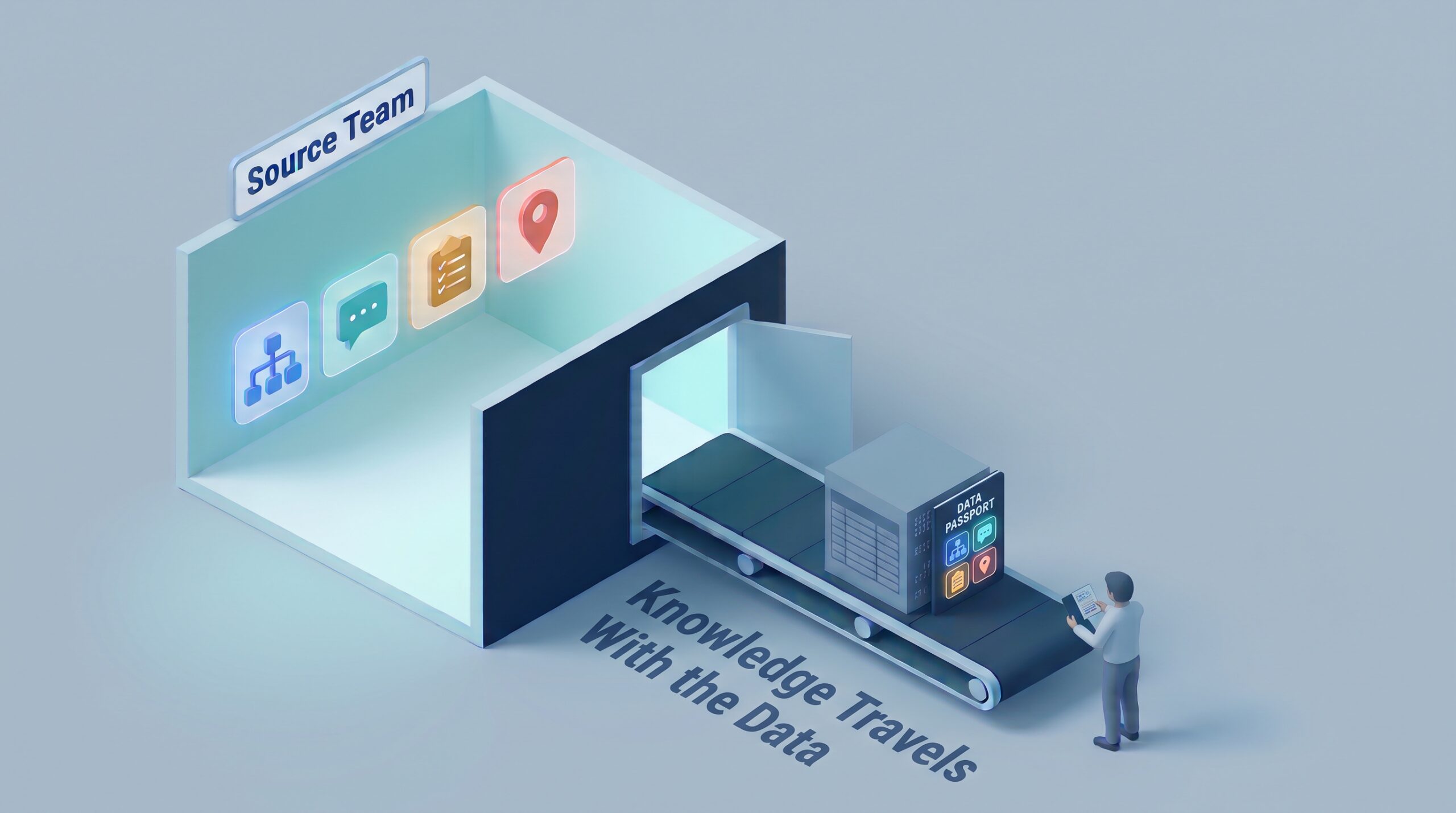
Unless we do it differently. The context that AI needs is the same context that BI needs, and data sharing, and data science, and the next migration to a new operational system. If we capture it properly, at the source, we give all of them the same foundation at once. And here is the good news: we can start with the technology we already have. What it requires is organising ourselves differently, so that the people who know the data capture it at the source, keep it up to date, and it always travels with the data from then on.
What “good luck with it” really costs
The cost of data without its papers rarely shows up as one big incident. It leaks away, quietly, everywhere.
Time. Every receiver starts from scratch. They study samples, compare columns, send emails, wait for answers. The same dataset is figured out again and again, by every team that uses it. Ask your data people how much of their week goes into understanding data rather than using it. The answer is usually uncomfortable.
Wrong decisions. When people guess, some guesses will be wrong. A unit is misread, a definition is assumed, a filter is missing. The report looks fine, the dashboard looks fine, and the decision built on it is quietly off. Nobody notices until the results are obviously wrong.
Take a field called customer_since. The reporting team uses it as the date the customer relationship began. The AI team uses it to predict loyalty. In fact, it holds the date the customer was loaded into the current system: every customer from before the last migration got the same date. Both teams process the field perfectly, and both reach the wrong conclusion. One line in the data’s papers would have prevented it.
Late surprises. Because nobody knows up front whether a dataset is usable, projects find out halfway through. The analysis is redone, the AI model is retrained, the go-live is delayed. The question “can we use this?” should have been answered on day one.
Risk you cannot see. Data is used for purposes it was never meant for, shared beyond what its licence allows, or fed into an AI model without anyone knowing it contained personal data. Not out of bad intent, but because nobody passed on the conditions.
Migrations that lose more than data. When a system is replaced, the data usually makes it across. The business rules, the exceptions and the reasons behind them often do not. The new system works, but nobody quite trusts it.
None of this is anyone’s fault. It is the predictable result of letting data travel without the knowledge that belongs to it.
When data comes with its papers
In every other field where important things move between parties who don’t know each other, we solved this long ago. A container does not cross a border without its documents. A medicine does not leave the factory without its leaflet. Nobody opens every box to guess what is inside. The food chain goes even further: every link in the chain records where a product came from and where it went, so the eggs or the lettuce on a supermarket shelf can be traced back to the farm and the farmer they came from, and recalled quickly if something is wrong. That traceability is a big part of why we trust what we eat.
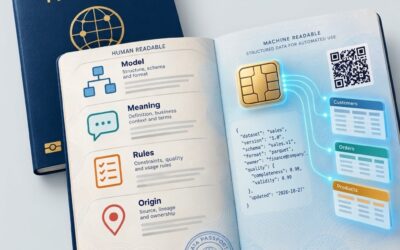
Data deserves the same: papers that travel with it, wherever it goes. What it means, which rules apply, what you may do with it, and who stands behind it. Captured at the source by the people who know, kept up to date, and readable by everyone who receives it, people and machines alike.
That is what I call a data passport. And alongside it, a Data Guardian: software that checks those papers where data arrives or leaves, and allows, flags or stops the handover according to agreed rules.
With a passport, “good luck with it” becomes “here is what you need to know”. Receivers start from understanding instead of guessing. Go/no-go decisions about data are made at the start, not halfway through. AI gets the context it needs. And when someone asks where the data came from and who said it could be used this way, there is an answer, with a name on it.
And we no longer have to play detective and follow a trail, because we have a record of everywhere the data has been, stamped by every system it passes through. A passport carries the origin of the data with it, and like a real passport it collects stamps along the way: every handover, every combination, every new use. A catalogue is a library you have to visit; a passport travels in the pocket of the data. Lineage no longer depends on an outside tool reconstructing it within one platform; it travels with the data, across platforms and organisations, wherever it goes.
We stopped sending a person along with the data a long time ago. We just never replaced what they knew.
If you want to see what a data passport contains and how the Data Guardian works, read Your Data Has No Papers – The Data Passport and the Data Guardian, v0.1.
And one question to take back to your organisation: look at the data behind your next big decision. Who signed for it?
Ronald Baan — Mastering Data, ronaldbaan.com