The passport describes the dataset. Each receiver then decides whether it fits their own use. That is why one passport can help a BI team, an AI team and a migration team at the same time: they all start from the same description, and each makes its own judgement.
Why a passport?
Whoever receives a dataset first has to work out what they have. How is it built? What do the fields mean? What may I do with it? Where does it come from? Usually this is reconstructed afterwards, and then the result describes what the data seems to be. A passport captures what the source says it is. For meaning and rules in particular, that difference is large.
Four facets, seven elements
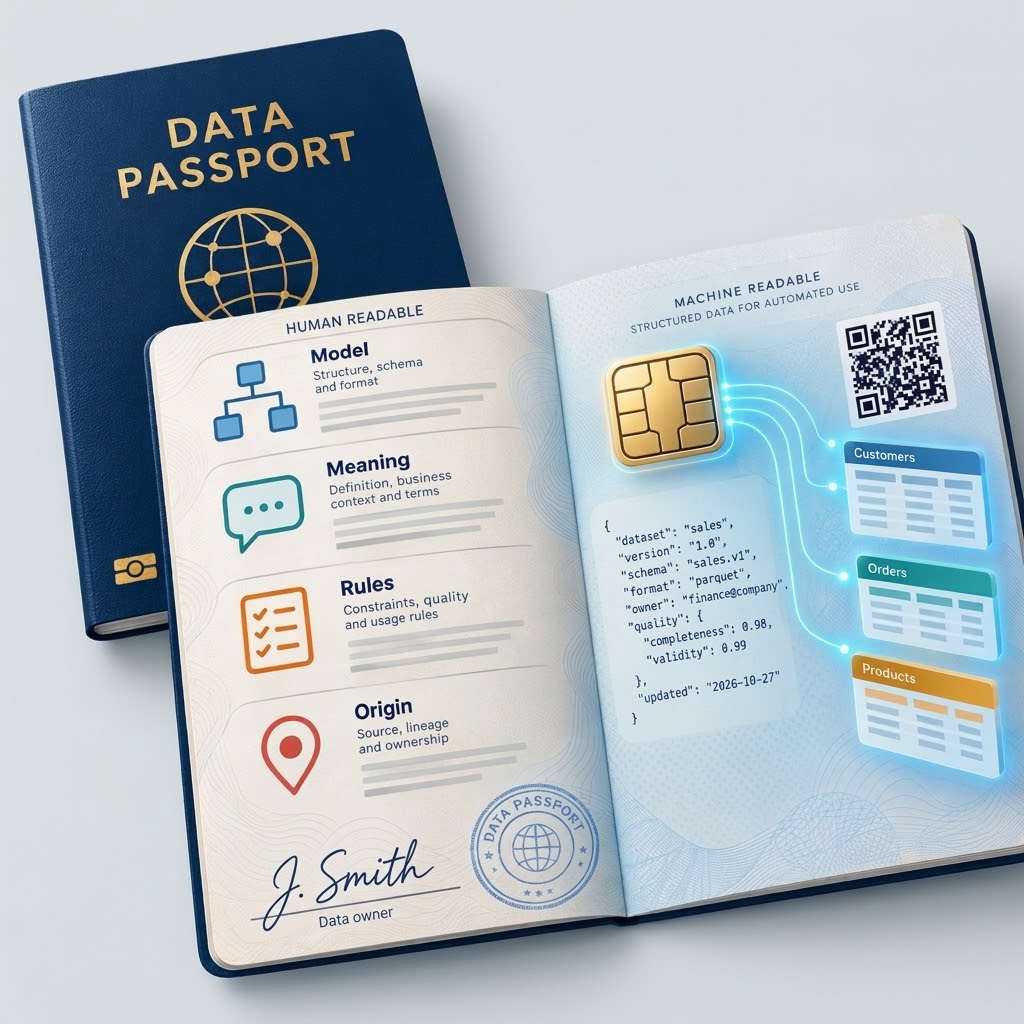
The passport has four facets for the conversation, and seven elements for the detailed version. Each element is named after what it lets the receiver do.
| Facet | Question | Elements: what the receiver can do with them |
|---|---|---|
| Model | How is it built? | Model (understand it): what one row represents, the fields, types and keys. Contents (read it): an objective profile, such as row counts and empty fields |
| Meaning | What does it represent? | Meaning (interpret it): terms, definitions, units and code lists |
| Rules | What must be true, what may I do with it? | Rules (check it): what must hold. Quality (judge it): how the data performs against those rules, measured. Conditions of use (use it): licence, permitted and forbidden purposes, GDPR and AI Act constraints |
| Origin | Where does it come from? | Origin (trust it): where it came from and who is accountable for it |
For every statement in a passport, two things are recorded. The basis tells you how a claim was established: declared by people who know the data, observed by measuring it, or assumed by a tool or an AI. The endorsement tells you who stands behind it.
Start small, grow
A passport doesn’t have to be complete on day one. Start with one dataset you already share. Describe what one row represents, define a field people often misunderstand, and name who can confirm the definition. That is already a useful passport, and from there it can grow:
- Readable passport. A person can read it, and knows who to ask.
- Machine-readable passport. Software and AI agents can read it, and checks can be generated from the rules.
- Passport with a Data Guardian. Software where data lands acts on the passport: it allows, warns, recommends or refuses, and drafts passports for combined datasets. It drafts, people sign.
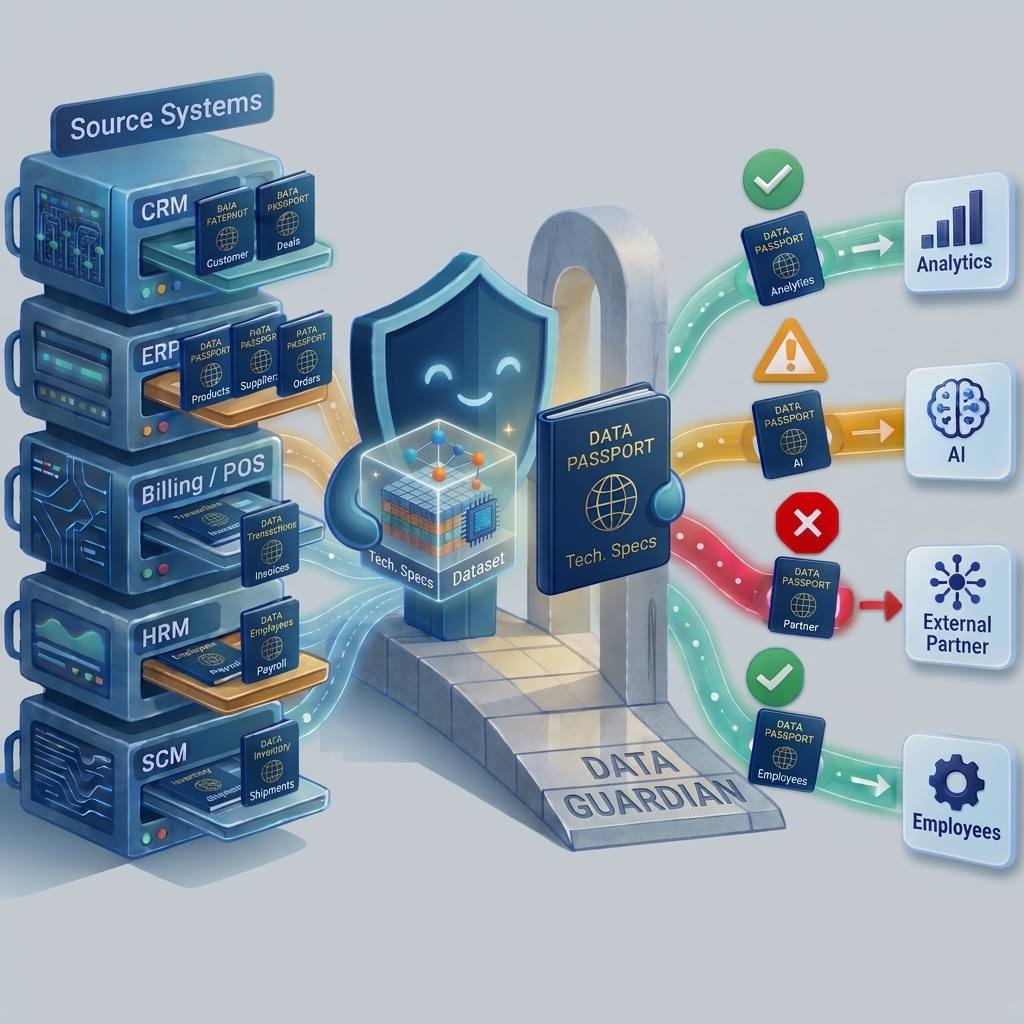
The passport describes what it must be able to do, not which format to use. A concrete passport can build on existing standards, as long as it is readable and exchangeable.
What it delivers
- Faster: read instead of reverse-engineer, faster mapping, and checks generated from the rules.
- Earlier decisions: go or no-go at the start, based on measured quality.
- More correct: meaning and rules straight from the source.
- Safer: fewer misinterpretations, explicit conditions of use and a named owner.
- Scalable: the producer describes it once, every receiver benefits, and AI gets context from the source instead of guessing.
- For the producer: fewer repeat questions, fewer surprises when data is misused, a clear record of accountability and conditions, and knowledge that stays when people leave.
How much preparation time could a passport save? We want to find out. We are looking for teams that can compare what a receiver has to find out with and without a passport.
What belongs in every data passport?
Think of a dataset you’ve had to work out for yourself. What would you want its producer to tell you before you started? Try the seven elements against that dataset, and tell us what’s missing, what you would leave out, and what would be hardest to provide. Your answer helps shape v0.2.